In the high-stakes arena of contemporary serious oversteer competition, victory is far more than solely a function of raw engine power or pilot courage. Conversely, it has evolved into a complex engineering challenge which demands a painstaking blend of selecting a inherently capable car, equipping it with the most precise competition components, and, most importantly, grasping its dynamic behavior on the circuit through cutting-edge vehicle dynamics analysis tools. This comprehensive manual functions as your roadmap from the initial idea of a competition vehicle through to the final telemetry-optimized adjustments that transform a capable car into a repeatable champion. We will delve deep into the precise engineering of chassis dynamics adjustment, showing how a modern suspension tuning tool like a dedicated telemetry system removes assumptions and offers exceptional clarity into your chassis's real-world dynamics.
The bedrock of any successful drift car is, without question, the base vehicle itself. Certain platforms have attained renowned standing within the international oversteer culture due to their built-in handling characteristics, durable build quality, and the immense range of performance parts available. Selecting the right platform is the primary and most important selection a enthusiast will make. As an example, the BMW's E36 3 Series is universally acknowledged as one of the best balanced cars for drifting of the modern era. Its almost ideal balanced front-to-rear weight, combined with a rear-wheel-drive setup and robust straight-six motors, forms a chassis that is both forgiving for beginners and highly capable in the hands of a professional driver. The evolution of this lineage, the BMW E46, builds upon these strengths with a increasingly sophisticated structure, broader wheel track for improved high-speed stability, and still more steering angle straight from the factory. Another dominant option in the professional circuit is the C6 generation Corvette.
This muscle-derived sports car brings a distinctive array of strengths to the sideways world, including a low-mass alloy structure, a rear-mounted gearbox and differential unit that aids in an ideal front-to-rear mass ratio, and the colossal thrust of a large-displacement LS-series V8 engine. This combination makes it an complete weapon on track, designed of initiating and holding continuous drifts with apparently minimal application of power. For drivers seeking outstanding performance per dollar, the Nissan 350Z rises above as a excellent example. It comes from the manufacturer with a stiff chassis, a effective original limited-slip differential, and the free-revving VQ35DE powerplant that provides plenty of horsepower and torque for practicing and advancing in the sport. Its newer version, the Nissan 370Z, brings further advancements in structural rigidity, suspension design, and peak engine performance, cementing its status as a favorite selection among serious drivers. Further historic vehicles that merit mention include the agile Wankel-engined FC generation RX-7, the ubiquitous Nissan S13, the American SN95 generation Mustang, the modern BMW E90, and the tiny yet incredibly engaging and teachable Mazda Miata. All of these cars offers a unique palette of characteristics, complexities, and possibilities, but they all have in common the fundamental elements required to serve as a serious sliding vehicle.
However, choosing the correct chassis is just the first step. To unlock the complete capability of any of these cars, major changes to the steering system and chassis control systems are utterly mandatory. This is where the domain of performance drift-spec hardware enters sharp importance. The single most transformative upgrade for a purpose-built drift machine is the installation of a high-performance angle modification kit. These advanced systems, for example those developed by industry leaders like specialist manufacturers, are created to dramatically increase the vehicle's possible turning lock. A factory road car is extremely limited in how far its tires can rotate, a safety compromise for public road driving. In oversteer driving, however, aggressive opposite lock is constantly needed to manage and sustain a angle. An angle kit exchanges the OEM steering knuckles, linkages, and sometimes control arms with pieces that enable the wheels to reach degrees of turn over 70 or even 80 degs, as opposed to a average stock limit of around 40 to 50 degrees.
This tremendously greater lock offers the pilot with significantly greater authority during a angle, enabling it to be considerably easier to initiate a slide, hold it through a sweeping corner, and switch smoothly from one side to another. The contrast in handling is absolutely profound. Paired with a appropriately chosen modification is the equally vital modification to the car's damping system. Off-the-shelf or even premium sport dampers are simply not engineered for the unique and harsh requirements of drifting. A purpose-built set of coilovers is paramount. These specific dampers feature specific piston tuning and spring strength that are tuned for the violent load shifting that is typical of drifting. When a driver begins a drift, the car's mass is transferred forcefully to the front of the turn. Proper drift-spec suspension control this transfer in a controllable way, enabling the vehicle to find its balance promptly and providing the pilot precise feedback through the controls and driver's seat. They also enable precise setting of ground clearance, damping firmness, and cross-weight, which are all integral parts of optimizing the chassis's dynamics to a particular circuit or driving style. As a system, a top-tier drift angle kit and a properly chosen system of competition coilovers form the core physical foundation upon which all subsequent refinement is constructed.
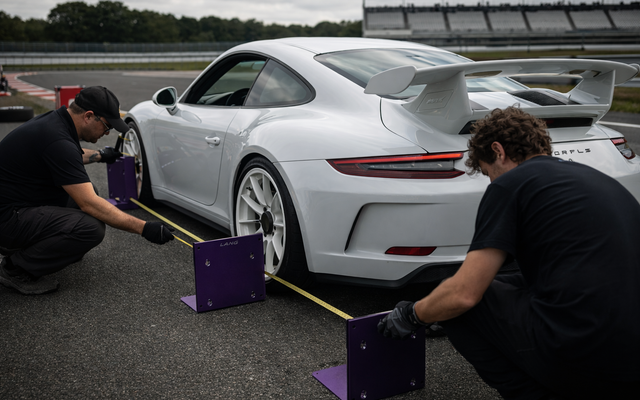
Once the core parts is fitted, the following vital phase in the build is the meticulous adjustment of the vehicle's alignment. This is the realm of vehicle alignment optimization, a procedure that can appear overwhelmingly complex to the newcomer but is, in practice, the secret to transforming a collection of fast parts into a cohesive and predictable vehicle. The most discussed element of tuning for sliding is definitely camber. Wheel camber is the tilt of the wheel compared to the perfectly straight axis when observed from the front of the car. When the top of the tire is tilted towards the car, this is referred to as inward tilt. For drifting, an inward tilt on the steering tires is universally employed and is considered necessary. The logic is deeply related to vehicle dynamics.
When a chassis is turning at limit angles, the frame rolls towards the outside of the corner. This lean causes the outside front wheel to lose its ideal footprint with the asphalt. By introducing negative camber, the tire is pre-leaned to account for this tilt. As the car tilts into the bend, the outside front tire gains a better contact patch with the asphalt, maximizing its grip at the precise moment when it is most required for control. Typically, front axle adjustments for a dedicated drift machine fall between approximately -3 degrees to as extreme as -5 degrees or even beyond, depending on the details of the car geometry, tire type, and pilot style. The rear tires also employ inward tilt, but the values are typically more modest and more nuanced than the front axle. Too much negative camber at the back can cause the vehicle to excessively loose and challenging to control on acceleration input, as it diminishes the effective tire footprint of the driving tires during linear acceleration. Therefore, rear camber settings are commonly in the ballpark of -1 degree to -3 degrees, finding a delicate balance between providing enough lateral grip to help in entering and maintaining the slide while also preserving good hook-up for power-down the turn. alignment is merely one element of the more complex suspension geometry picture, which additionally involves toe, caster angle, and steer correction correction.
Toe refers to the angle of the wheels as seen from a bird's-eye view. Inward toe means the leading edges of the wheels are nearer together than the rear edges, while toe-out means the converse. For sliding, a slight amount of front toe out is commonly employed to improve the initial handling feel, making the vehicle feel more responsive and willing to initiate a slide. Rear toe angle is usually set to zero or a incredibly minute amount of inward toe to encourage stability under power. caster angle is the forward or aft tilt of the kingpin axis when observed from the side of the chassis. Increased caster angle enhances steering feel and stability solidity, and it also boosts inward lean effect during steering, which is highly beneficial. Tuning these settings is a detailed dance where a modification to a single setting can and will affect the other settings. The old-school approach for tuning a vehicle's suspension geometry for sliding has historically been a labor-intensive affair of trial and error. A driver or team would introduce a modification based on a hunch, run the chassis on track, depend on the pilot's personal sensation and comments, and then apply another adjustment. This cycle would iterate time after time until the chassis felt "right" or the allotted track period ended. This methodology is not just exceptionally slow in terms of time and resources, but it is furthermore deeply inaccurate.
Human sensation is a infamously inconsistent data source, affected by numerous factors such as exhaustion, varying track conditions, weather, and just the mood of the operator on that specific day. What feels "tail-happy" on one pass might feel "understeery" on the next run, leading to contradictory information and frustrating changes. This age-old limitation in vehicle dynamics optimization is specifically where contemporary technology has intervened to revolutionize the methodology.
The advent and adoption of specialized vehicle dynamics tools has ushered in a completely new era for engineering and perfecting high-performance drift cars. These platforms, exemplified by groundbreaking systems like GripDial, operate by actively measuring the real-time mechanical performance of the vehicle as it is being driven on the circuit. As opposed to relying on subjective impression, these systems acquire objective information on critical factors such as shock absorber movement, corner velocities, lateral and longitudinal g-forces, wheel angle, and driver input input. This acquired telemetry is then processed by powerful software that can visualize and interpret the information in a clear manner. For the first time, tuners and teams can visualize specifically what the chassis is exhibiting at each point of a lap. This ability changes the whole suspension tuning procedure. Imagine the specific challenge of setting the front axle negative camber for a specific chassis. Rather than applying a change from -3 degrees to -3.5 degrees and then driving many passes to try and "perceive" a change, a vehicle dynamics tool can provide immediate and definitive data. The application can show graphically how the suspension's loading is performing during the critical stages of a drift: initiation, holding the angle, and transition. It can show if the current value is enabling the outside front tire to achieve ideal contact or if the rubber is over-stressed on its external shoulder.
The system can subsequently provide data-driven suggestions for change. Perhaps the information indicates that the outside front tire is even overworking its outer shoulder at -3.5 degrees of negative camber, indicating that even more inward lean, say -4 degrees, might be beneficial. Conversely, the information might indicate that the tire is not coming up to temperature or that the inside edge is degrading too quickly, which could point to that there is excessive inward lean and a small reduction back to -3.2 degrees would be better optimal. This level of granularity and useful analysis was completely impossible in the days of solely manual adjustment.
The impact of employing car alignment tuning a comprehensive vehicle dynamics tool extends well beyond just optimizing alignment. It functions as an priceless damper adjustment manual that is customized to your exact chassis. When fine-tuning the damping values on your suspension, rather than using vague tips or mimicking another team's setup, you can employ the software to observe how the chassis is performing in relation to your changes. The software can display the suspension travel path over a lap, revealing if the shocks are handling the body movement properly or if they are permitting the car to become unsettled uncontrollably after a flick. It can assist in pinpointing problems like bottoming out or topping out, permitting you to apply educated choices to preload settings, damping values, or ride height. This methodology translates similarly to the complex art of suspension geometry optimization. Beyond camber angle, the system can provide data into how modifications to toe and caster angle are impacting the car's handling during specific phases of a slide. For instance, it can assist you to determine the optimal amount of front negative toe for your specific angle kit configuration and driving style by measuring the response time of turn-in reaction and the stability of the vehicle at lock lock. This turns the tool an extremely effective drift suspension tuning guide that is actively informed by the actual behavior of your personal car on the track. It elevates the complete endeavor from a subjective skill into a repeatable development exercise.
Moreover, the application of a system like modern telemetry is in no way limited to expert tuners with extensive budgets. For the amateur enthusiast, it functions as an powerful force multiplier. It practically gives the tuner with the analysis of a professional dynamics engineer without requiring the typical cost. It accelerates the learning curve by providing clear answers to problems that would traditionally take years of trial and error to answer. A builder can understand how their particular car reacts to drift tuning app various adjustments, developing a more profound understanding of vehicle dynamics in the process. It also democratizes professional chassis dynamics techniques, enabling all drivers with the desire to perfect their car to accomplish it in a structured and productive way. This is particularly valuable in a activity like sliding, where engineering knowledge has traditionally suspension engineering been a highly secretive asset among professional teams. Today, that power can be in the hands of any serious builder.
In summary, the path to constructing and tuning the perfect high-performance drift car is a multi-faceted mission that seamlessly combines proven mechanical wisdom with 21st-century digital technology. It starts with the informed selection of a legendary car, followed by the installation of essential drift-spec parts like drift-spec drift angle kits and correctly specified performance coilovers. The process then progresses into the precision stage of car suspension tuning, where parameters like camber, toe, and caster are meticulously set to suit the car's modified geometry and the pilot's individual style. Finally, and what really separates the today's process from the traditional methods, is the integration of a powerful drift telemetry software. This tool eliminates the approximation and waste of purely seat-of-the-pants tuning by giving objective, actual telemetry on how the car is actually functioning. It functions as an unparalleled diagnostic aid, a comprehensive drift suspension tuning guide, and a master vehicle dynamics tool. As a complete package, this complete approach ensures that all element of the drift car—from the pick of the platform to the final tweak on the damper—is perfected for peak performance on the circuit. It represents the total evolution of the art of drifting, connecting raw pilot talent with surgical suspension engineering to forge the most dominant machines attainable.